
A felony conviction does not automatically prevent a U.S. citizen from getting a passport.
For someone who has served the sentence, completed probation or parole and has no active warrant or court order restricting travel, an old felony conviction by itself does not create a lifetime passport ban.
Federal law focuses on specific legal barriers that may still exist when you apply. An outstanding felony warrant is one. A court order that forbids leaving the United States is another. Certain drug convictions involving an international border have their own federal rule. Child-support arrears and serious federal tax debt can block a passport for reasons completely separate from the conviction.
A passport is also not permission to leave under a court order. It proves identity and U.S. citizenship for international travel. A judge, probation condition or parole condition can still restrict your movement.
And even after the State Department issues the passport, the country at the other end of the flight decides if it will admit you.
Here is where the rules stand in 2026.
Most Felony Convictions Do Not Create a Passport Ban

Federal passport regulations do not contain a blanket provision stating that every person with a felony record loses passport eligibility.
Instead, 22 CFR 51.60 identifies specific circumstances in which the State Department cannot or may refuse to issue a passport.
One provision allows refusal when the applicant is the subject of an outstanding Federal warrant of arrest for a felony.
Section 51.60(b) also covers certain criminal court orders, probation or parole conditions forbidding departure from the United States, extradition requests, federal felony subpoenas and outstanding state or local felony warrants.
That is why the age of a conviction tells you less than many people assume. The important question is what remains legally active today.
Here Are the Most Common Cases that Raise Questions
| Situation | Actual Passport Rule | What to Check | Primary Source |
|---|---|---|---|
| Old felony, sentence completed | No general federal rule creates a lifetime passport ban solely because the conviction exists. | Check for an active warrant, supervision condition or separate statutory restriction. | 22 CFR 51.60 |
| Federal felony warrant | The State Department may refuse a passport when an outstanding federal felony arrest warrant exists. | Confirm the warrant has been formally cleared before applying. | 22 CFR 51.60(b)(1) |
| State or local felony warrant | An outstanding state or local felony arrest warrant is also listed as a ground for refusal. | Check the court record rather than assuming an old case is closed. | 22 CFR 51.60(b)(9) |
| Probation or parole | A restriction applies when a criminal court order, probation condition or parole condition forbids departure and violation could result in a federal arrest warrant. | Read the actual supervision order and obtain any required travel approval. | State Department guidance |
| Certain drug convictions | The restriction applies when a qualifying drug offense involved use of a U.S. passport or crossing an international border, during imprisonment or supervised release. | Review the conviction, conduct and supervision period. | 22 U.S.C. § 2714 |
| Child-support arrears | Passport issuance is denied after certification when arrears exceed $2,500. | Resolve the certification through the state child-support agency. | 42 U.S.C. § 652(k) |
| Serious federal tax debt | Passport issuance can be denied after IRS certification under IRC § 7345. | Check for a CP508C notice or IRS certification. | IRC § 7345 |
| Covered sex offender | A passport book must contain the statutory identifier. A passport card is not issued. | Confirm covered status and follow the special application requirements. | 22 U.S.C. § 212b |
An Old Conviction Is Different From an Active Restriction
Imagine someone convicted of felony theft in 2011. The person served the sentence, completed parole several years later and has no warrant or current court restriction.
Federal passport law does not impose a permanent ban simply because the conviction remains in the criminal record.
Now change one fact. Suppose the person missed a later court appearance and an active felony warrant remains on file.
The old theft conviction is no longer the immediate issue. The warrant is.
An old case that was never fully closed is a bad thing to discover after paying for flights. Warrant status should be checked before the passport application and before travel is booked.
A bench warrant also deserves a closer look, although not every bench warrant is automatically a felony warrant covered by the passport regulation. The underlying case and the exact warrant classification control the answer.
Probation and Parole Require a Look at the Actual Order

Probation or parole does not create an automatic passport ban.
The wording of the supervision order decides far more.
Under 22 CFR 51.60(b)(2), the State Department may refuse a passport when a criminal court order, probation condition or parole condition forbids departure from the United States and violating the restriction could lead to a federal arrest warrant.
One person may be allowed to travel after receiving written approval. Another may be prohibited from leaving the country until supervision ends.
- a discharge notice from the probation officer
- a termination letter from the probation officer
- a court order ending supervised probation or parole
The same State Department page explains another situation that people easily confuse with applying for a new passport.
If a court or law enforcement agency previously sent a still-valid passport to the State Department, asking for that passport back is a separate procedure. A person requesting its return generally needs a notarized request and an official letter from the probation officer authorizing release of the passport.
The State Department says that return process can take up to eight weeks.
Our guide to probation and parole differences explains why the two forms of supervision should not be treated as the same legal status.
A Passport Does Not Cancel a Travel Restriction
A person can possess a valid passport and still be prohibited from leaving the country.
Suppose your passport expires in 2032, but your current probation order says international travel requires court approval. The expiration date printed in the passport changes nothing about that condition.
Leaving without permission could create a new supervision violation even though the passport itself remains valid.
Certain Drug Convictions Have a Specific Federal Passport Rule
Drug convictions are one of the few areas where Congress directly tied the underlying crime to passport eligibility.
Under 22 U.S.C. § 2714, a passport cannot be issued during the covered period when a person was convicted of a qualifying federal or state drug offense and used a passport or crossed an international border while committing the offense.
For a felony, the restriction applies during the period in which the person is imprisoned or legally required to be imprisoned and during parole or other supervised release after imprisonment.
That makes the rule far narrower than the phrase “drug felons cannot get passports.”
A domestic drug conviction with no passport use and no international border crossing does not automatically fall under § 2714 simply because drugs were involved.
The statute also gives the Secretary of State authority to issue a passport in emergency circumstances or for humanitarian reasons.
The Border Element Is the Key Fact
Consider two convictions for drug distribution.
In the first case, all conduct took place within one state. In the second, the person transported controlled substances across an international border.
The federal passport statute expressly addresses the second situation because of the international element. Treating both cases as identical would give readers the wrong rule.
Child Support Has a Precise $2,500 Threshold
A person can have no criminal record at all and still be denied a passport because of unpaid child support.
Under 42 U.S.C. § 652(k), when a state child-support agency certifies that an individual owes arrears exceeding $2,500, the certification is transmitted for passport action. The Secretary of State must refuse to issue the passport and may revoke, restrict or limit an existing passport.
The State Department gives the same threshold in its current “Passports and Child Support Debt” guidance.
If the debt is paid or otherwise resolved, the process does not end the same day. The State Department warns that the state and Department of Health and Human Services process for removing a person’s name from the federal record may take a minimum of two to three weeks.
Anyone with urgent travel should account for that delay before assuming a payment will clear the passport restriction immediately.

For 2026, the Federal Tax Threshold Is $66,000
Federal tax debt has a different set of rules and a much higher dollar threshold.
Under IRC § 7345 and current IRS passport guidance, seriously delinquent federal tax debt for 2026 means qualifying, legally enforceable federal tax debt totaling more than $66,000, including assessed interest and penalties.
The number is inflation-adjusted. IRS guidance lists $64,000 for 2025 and $66,000 for 2026.
Crossing $66,000 alone does not automatically trigger passport action.
The IRS must also have taken specified collection steps. Its guidance says the agency must have filed a Notice of Federal Tax Lien and allowed the administrative remedies to lapse or be exhausted, or issued a levy.
Once the IRS certifies the debt to the State Department, a new passport or renewal can be denied and an existing passport can face revocation.
A taxpayer receiving certification is sent Notice CP508C.
Some Tax Debts Are Excluded
The IRS lists several categories that are not certified as seriously delinquent tax debt for passport purposes.
- Debt being paid on time through an approved installment agreement
- Debt covered by an accepted offer in compromise
- FBAR penalties
- Certain Department of Justice settlement agreements
- Child-support debt, which follows its own passport process
A felony conviction has no role in that tax test.
International Megan’s Law Does Not Create a Blanket Passport Ban
Sex-offense cases require more precise language than many online guides provide.
International Megan’s Law applies to a person who meets the federal definition of a covered sex offender, including a person currently required to register for a qualifying sex offense against a minor.
Under 22 U.S.C. § 212b, the State Department cannot issue a passport to a covered sex offender unless the passport contains the required unique identifier. The Department may also revoke a passport previously issued without it.
The current State Department rules add another practical detail. Covered sex offenders may receive a passport book carrying the identifier, but they cannot receive a passport card.
The page was last updated April 17, 2026.
That is very different from saying that every person convicted of a sex offense is permanently barred from holding a passport.
Expungement Is Not a Passport Requirement
Expungement can be valuable for employment, licensing, housing and other consequences of a criminal record. Passport eligibility is a separate question.
A person does not need an expungement simply because a felony appears on the record.
If no federal passport restriction applies, there may be nothing for an expungement to change in the passport process.
State expungement laws also differ considerably. Terms such as sealing, set-aside, dismissal and expungement do not produce identical legal results, and a record hidden from the general public does not necessarily disappear from every government database.
An expungement also does not automatically clear an unrelated felony warrant, supervision order, child-support certification or federal tax certification.
A Pardon Is Not a Standard Step Either
A pardon can alter some consequences of a criminal conviction, but most former felons do not need a pardon simply to submit a passport application.
The first job is to identify the actual legal barrier.
If the obstacle is a felony warrant, the warrant needs attention. If it is a probation condition, the court or supervising authority controls the travel restriction. If it is a tax certification, the IRS process governs the fix.
Pursuing a pardon without knowing which rule is blocking the passport can send someone into a lengthy process that does not address the real problem.
How Do You Apply for a Passport With a Felony Record?
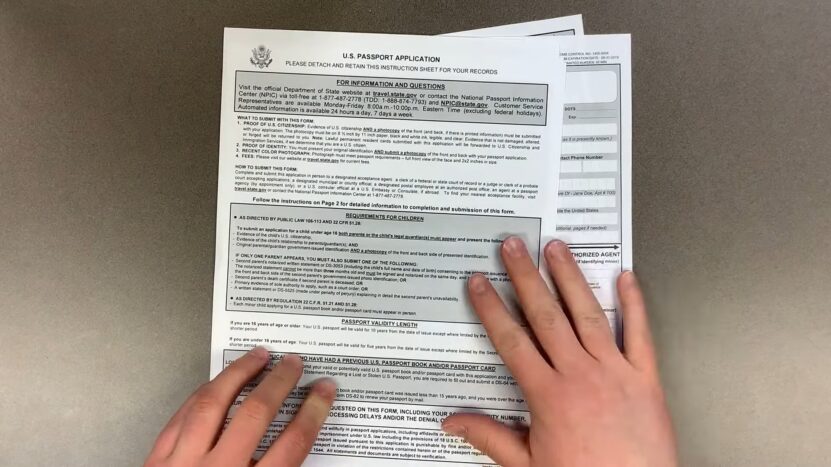
There is no separate passport form for people with felony convictions.
A first-time adult applicant generally uses Form DS-11 and provides the same core documents required from other applicants, including evidence of U.S. citizenship, acceptable identification, a compliant photograph and the required fees.
Criminal history becomes important when it triggers one of the specific federal rules covered above.
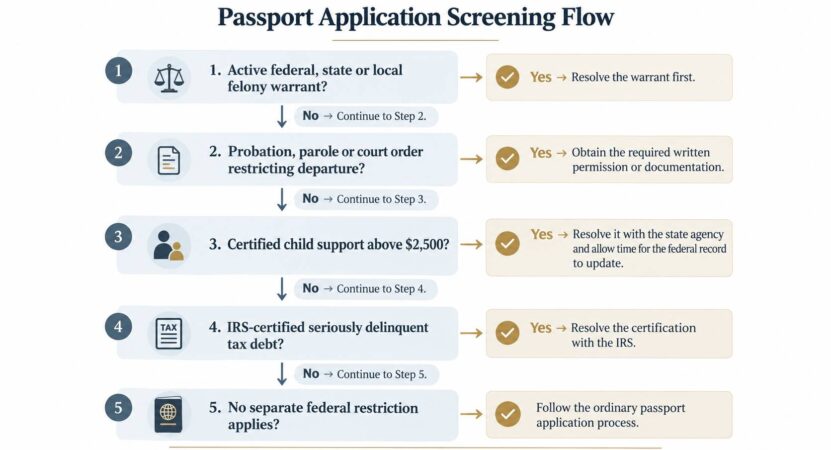
Each “yes” points to a separate legal barrier with its own procedure. Only the final branch leads directly to the ordinary application process.
Before You Apply, Check the Record That Exists Today
- Confirm that no felony warrant remains active.
- Read every current probation, parole or supervised-release condition.
- Check any criminal court order dealing with international travel.
- Review the facts of a drug conviction involving international travel.
- Check certified child-support arrears.
- Review any IRS CP508C notice or passport certification.
- Locate discharge papers if supervision recently ended.
- Find out what happened to any passport surrendered to a court.
Those checks tell you far more than the simple fact that a felony conviction exists.
A U.S. Passport Does Not Guarantee Entry Into Another Country
Passport eligibility answers the U.S. side of the trip. Admission abroad is controlled by the destination country.
Canada shows how different those two systems can be.
Canadian immigration authorities can find a foreign visitor criminally inadmissible based on conduct or convictions that would constitute an offense under Canadian law. Canada’s criminal inadmissibility guide explains routes including individual rehabilitation and deemed rehabilitation.
For some convictions outside Canada, deemed rehabilitation can become available after at least 10 years have passed since completion of the sentence, provided the Canadian offense falls within the qualifying category. Individual rehabilitation can become available after five years in qualifying cases.
A conviction serious enough to carry a Canadian maximum sentence of 10 years or more follows different rules and does not qualify for automatic deemed rehabilitation under that provision.
None of those Canadian rules changes U.S. passport eligibility. They answer a separate question about admission at the Canadian border.
Four Records Can Produce Four Different Answers

A Completed Felony Sentence
One traveler completed a felony sentence and parole years ago. No warrant, court restriction, qualifying debt certification or special federal passport rule remains.
The old felony alone does not create a general federal passport ban.
Probation With a No-Travel Condition
Another traveler holds a valid passport but is still serving probation under a court order that prohibits leaving the United States without permission.
The passport does not override the order. Written authorization needs to come first.
A Drug Conviction Involving a Border
A third traveler was convicted of a qualifying felony drug offense after crossing an international border as part of the crime and remains on supervised release.
22 U.S.C. § 2714 directly addresses that situation during the covered period.
An Old Felony With Child-Support Certification
A fourth traveler finished a felony sentence long ago but now has more than $2,500 in certified child-support arrears.
The old felony may have no role in the passport problem. The child-support certification can block issuance on its own.
Frequently Asked Questions
Final Words
A felony conviction by itself does not answer the passport question.
Federal law is far more specific. An active felony warrant can stop an application. A probation or parole condition can prohibit departure. Certain drug crimes involving international travel trigger a statutory restriction during imprisonment or supervised release. Certified child-support arrears above $2,500 and qualifying federal tax debt above $66,000 in 2026 operate under separate federal rules.
Start with what exists in the record today.
Check the warrant status. Read the supervision order. Find the discharge paperwork. Review any child-support or IRS certification. If the State Department previously received your passport from a court or law enforcement agency, determine if you need a new passport or the return of the existing one.
After that comes the second part of the trip. The State Department decides if you qualify for a U.S. passport. The destination country decides if you qualify to enter.
Those are separate legal decisions, and treating them separately gives you a far clearer answer than asking only if “a felon can get a passport.”