

You made a mistake years ago. You paid the fine, completed probation, or served your sentence. Now you are applying for a job, renting an apartment, or trying to move on with your life. One question keeps coming back. Is that misdemeanor still on your record?
A misdemeanor conviction can stay on your criminal record permanently unless it qualifies for expungement, sealing, or another form of legal relief. Some states automatically clear eligible records after a waiting period. Others require you to file paperwork with the court.
The waiting period can be as short as a few years, but there is no nationwide rule requiring misdemeanor convictions to disappear after seven years.
Your state, the offense, and the outcome of the case determine what happens next. An arrest that never led to a conviction may also follow different rules.
How Long Does a Misdemeanor Stay on Your Record in Each State?
Many people assume that a misdemeanor disappears after seven years. That is not how criminal records work. A conviction can remain publicly available for decades, even after every part of the sentence has been completed.
Several states now have laws that make it easier to seal or clear eligible misdemeanor convictions. However, the waiting periods and conditions are different.
| State | Waiting Period or Rule | What Happens to the Record? |
|---|---|---|
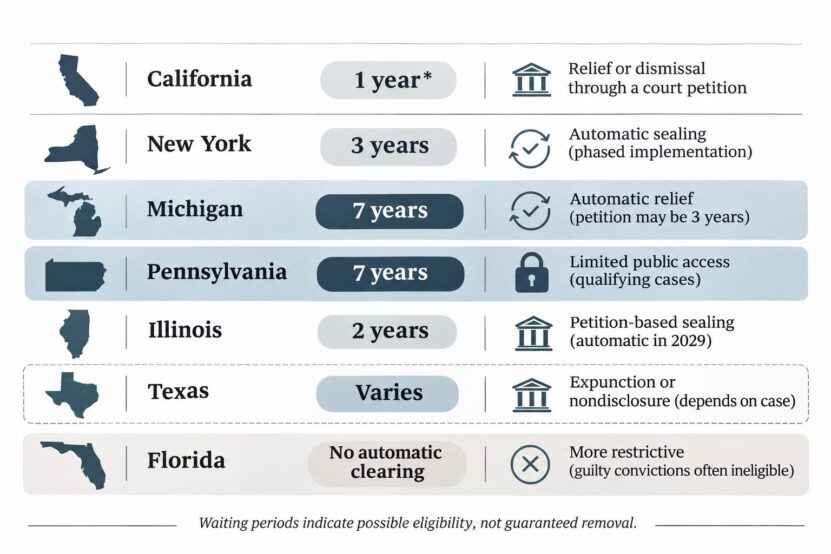
| California | Many eligible convictions receive relief after probation or one year after judgment for cases without probation. | Eligible convictions may receive automatic relief or dismissal through a court petition. |
| New York | 3 years after sentencing or release from incarceration, whichever is later. | Eligible convictions qualify for automatic sealing under the Clean Slate Act. Implementation continues through November 2027. |
| Michigan | 7 years after sentencing for automatic relief. Some misdemeanors qualify for petition-based relief after 3 years. | Eligible convictions may be automatically set aside or cleared through a court application. |
| Pennsylvania | 7 years for qualifying lower-level misdemeanors under Clean Slate rules. | Eligible records receive limited public access when statutory conditions are met. |
| Illinois | Generally 2 years after completing the sentence for eligible misdemeanor sealing petitions. | Eligible records may be sealed through a petition. Automatic sealing is scheduled to begin in 2029. |
| Texas | Depends on the offense and disposition. Some nondisclosure cases require waiting up to 5 years. | Eligible cases may qualify for expunction or an order restricting public disclosure. |
| Florida | No general waiting period that automatically clears adult misdemeanor convictions. | Many cases with an adjudication of guilt do not qualify for ordinary court-ordered sealing or expungement. |
The periods above are eligibility rules, not guaranteed record removal dates. Offense exclusions, later convictions, restitution requirements, and incomplete sentences can change the outcome.
For example, Michigan automatically sets aside many qualifying misdemeanors after seven years. Florida is much more restrictive when a person has been formally adjudicated guilty.
Does a Misdemeanor Automatically Disappear After 7 Years?
No. Seven years is one of the most misunderstood numbers in criminal background checks.
The confusion comes partly from the Fair Credit Reporting Act, which restricts how long certain negative information can appear in consumer reports.
However, federal background check rules generally do not impose a seven-year reporting limit on criminal convictions.
Consider someone convicted of misdemeanor theft in 2016. If the conviction was never sealed, expunged, or otherwise restricted, a background screening company may still be able to report it in 2026, subject to applicable state laws.
The same does not necessarily apply to an arrest that ended without a conviction. Different reporting limits and record clearing rules may apply.
Completing your punishment does not erase the historical record of the case.
What Is the Difference Between a Misdemeanor Arrest and a Conviction?
Before trying to clear a misdemeanor, you need to know exactly how the case ended.
Being arrested is not the same as being convicted. You might have been arrested, appeared in court, and had the charge dismissed. Another person might have pleaded guilty and received probation.
Both cases can create criminal records, but they do not receive the same legal treatment.
| Case Outcome | What It Means for Your Record |
|---|---|
| Arrest Without Charges | An arrest record may exist even though prosecutors never filed a case. Record clearing may be available. |
| Charges Dismissed | The case ended without a conviction, but court and arrest records may remain accessible. |
| Not Guilty Verdict | You were acquitted. The arrest and court records may still exist until sealed or expunged. |
| Misdemeanor Conviction | A finding of guilt can remain on your criminal history unless legal relief applies. |
| Deferred Adjudication | The outcome depends on the program and state law. Successful completion may provide access to record relief. |
Getting the official court disposition is important because it identifies the final outcome. A person who had charges dismissed should not automatically assume that the same expungement restrictions apply to someone convicted of the offense.
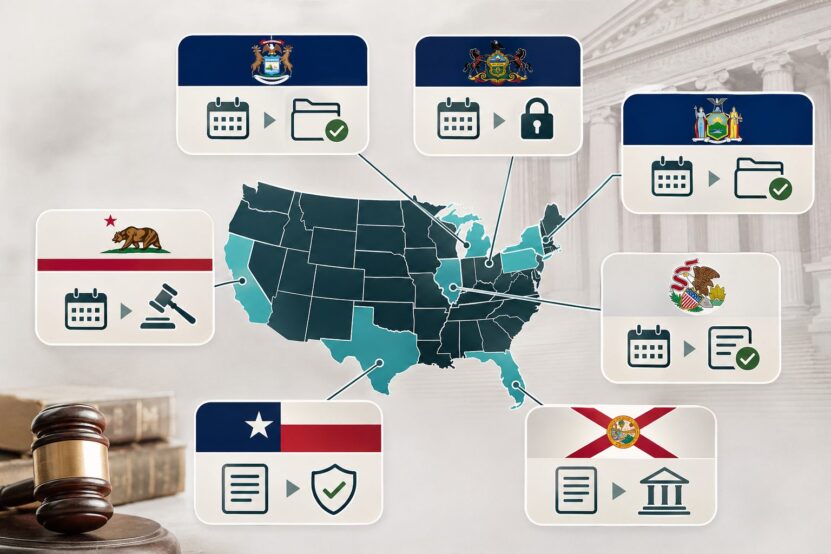
Which States Make It Easier to Clear Misdemeanor Records?
Record clearing has changed considerably in recent years. Some states have introduced automatic systems, reducing the need for people to hire attorneys or file individual petitions.
California
California allows many eligible misdemeanor convictions to receive automatic record relief. People who completed probation may also qualify for a court dismissal, and certain cases without probation require at least one year after conviction before a petition can be filed.
According to the California Courts record cleaning guide, eligibility depends on factors including pending cases and probation status.
A dismissed conviction does not mean every government agency loses access to the original history. Some legal consequences may remain.
New York
New York passed its Clean Slate Act to automatically seal many eligible criminal convictions.
For misdemeanors, the waiting period is three years after sentencing or release from incarceration, whichever comes later. The person must also satisfy other conditions, including restrictions involving pending cases and supervision.
According to New York Courts, the state has until November 16, 2027, to complete implementation. An older conviction that meets the waiting period may therefore not have been sealed yet.
Michigan
Michigan is particularly important for people with older misdemeanor records.
Its automatic system can set aside eligible convictions seven years after sentencing. Some qualifying misdemeanors can also be cleared through an application after a shorter waiting period.
The Michigan Attorney General explains that many misdemeanors qualify for petition-based relief after three years, although certain serious offenses follow different rules.
Pennsylvania
Pennsylvania automatically restricts public access to certain misdemeanor convictions under its Clean Slate law.
For qualifying second-degree and third-degree misdemeanors, the general waiting period is seven years without specified new convictions. Payment of court-ordered restitution is also required.
Eligibility is governed by Pennsylvania Section 9122.2. More serious offenses can follow different rules or be excluded.
Illinois
Illinois generally allows eligible misdemeanor convictions to be sealed through a court petition two years after completion of the sentence.
The state has also adopted an automatic sealing program, although implementation is scheduled to begin in 2029, with older cases processed in phases.
People who already qualify can pursue the existing petition process rather than waiting for automatic relief. Eligibility and exclusions are explained by Illinois Legal Aid Online.
Texas and Florida
These two states require particular attention because the final outcome of the case can determine eligibility.
Texas distinguishes between expunction, which can remove qualifying records, and nondisclosure, which restricts public access. Certain people who completed deferred adjudication or qualifying misdemeanor supervision may be eligible for relief.
The Texas State Law Library explains the available procedures and important eligibility differences.
Florida generally does not allow ordinary sealing or expungement when someone has been adjudicated guilty of an adult criminal offense. Qualifying dismissed cases and cases where adjudication was withheld may receive different treatment.
The Florida Department of Law Enforcement also explains that receiving a certificate of eligibility does not automatically seal a record. A court order is normally required.
Will a Misdemeanor Show Up on an Employment Background Check?

Yes, an unsealed misdemeanor conviction may appear when an employer runs a criminal background check.
The result depends on the screening provider, state law, the employer, and the type of position. A basic background check may not retrieve the same information as a fingerprint-based check for a licensed profession.
For example, a restaurant employer and a government agency may have different legal requirements for reviewing criminal history.
A misdemeanor conviction does not automatically disqualify someone from every job. Employers may consider the nature of the offense, its connection to the position, and the time that has passed. Applicable discrimination and fair chance hiring laws can also limit how employers use criminal records.
For people with more serious convictions, the options may differ. Some states allow felony convictions to be cleared through separate expungement or sealing procedures.
Can You Remove a Misdemeanor From Your Criminal Record?
Potentially, yes. The two common methods are expungement and record sealing, although states use additional procedures and the legal effects are not identical everywhere.
Expungement
Expungement can remove a qualifying criminal record or restrict its legal availability. In some jurisdictions, records may be destroyed. Others retain certain information for specific legal purposes.
Eligibility often depends on the offense, case outcome, criminal history, and sentence completion.
Record Sealing
Sealing generally restricts public access without necessarily destroying the underlying record.
Ordinary employers and members of the public may no longer see a properly sealed case, but law enforcement and certain authorized agencies may retain access.
Neither process should be assumed to restore firearm rights, eliminate immigration consequences, or remove every legal restriction connected to a conviction.
How to Find Out if Your Misdemeanor Can Be Cleared
Start with the court where your case was handled. You need the correct case information before calculating any waiting period or submitting an application.
- Get your court records. Request the case number, charges, final disposition, sentencing date, and information about any probation.
- Identify the conviction state. Record clearing is generally controlled by the jurisdiction where the case occurred, not where you currently live.
- Check the eligibility requirements. Review the waiting period, excluded offenses, unpaid restitution, and restrictions involving new convictions.
- Find out if relief is automatic. Some states clear eligible cases without an application. Others require a court petition.
- Submit the required documents. If a petition is necessary, follow the instructions provided by the court or official state agency.
- Confirm that the record was updated. After relief is granted, obtain the order and check that the relevant criminal history databases reflect the change.
People who received probation should pay particular attention to the completion date and any remaining supervision requirements. Our explanation of probation and parole rules covers how the two forms of supervision differ.
Frequently Asked Questions
Final Thoughts
A misdemeanor may seem like a small part of your past until it appears during a job application or rental screening years later.
The good news is that more states now provide ways to clear eligible convictions, sometimes automatically. The important part is finding out what happened in your case and which law applies.
Do not assume your misdemeanor disappeared because seven years have passed. Get your court record, check the current rules in the state where you were convicted, and find out if you qualify for sealing or expungement.